

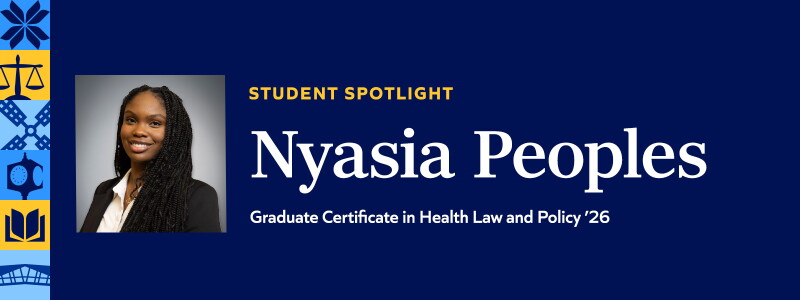
Nyasia Peoples didn’t set out to become a healthcare law expert. Like many students who find their calling, she took a winding path — one that started with a criminal justice degree, detoured through a pharmacy during a global pandemic, and eventually led her to a paralegal desk at a law firm’s healthcare division.
Somewhere along that journey, a pattern emerged. Every role, every experience, every late-night shift was pointing her toward the same intersection: healthcare and law.
“I realized I wanted to put this passion somewhere,” Peoples said. “And I realized I wanted to go into law.”
That realization led her to Hofstra University’s online Certificate in Health Law and Policy program, which she completed in 2026. Through the program, she found more than a credential to add to her resume. She found the framework, the language, and the confidence to step into law school knowing exactly where she belonged.
When the Pieces Start to Connect
After earning her undergraduate degree in criminal justice, Peoples wasn’t sure what came next. She knew she wanted to help people. She knew she was drawn to systems, rules, and advocacy. But the path forward felt unclear.
Then came an opportunity at a pharmacy, right in the middle of the COVID-19 pandemic.
“I ended up falling in love with it,” she said of her work at the pharmacy. “I worked there for a year or so, which was pretty big because it was during the pandemic. So just being able to be a part of that and helping people really ignited my passion for [healthcare].”
Working as a pharmacy technician during one of the most challenging periods in modern healthcare gave Peoples a front-row seat to how the system worked — and where it broke down. She saw firsthand how policies, regulations, and legal frameworks shaped every interaction, every medication dispensed, every patient served.
“I worked as a pharm tech, and I realized that I wanted to do a little bit more,” she said.
That desire for depth led her to transition into a paralegal role at a law firm, specifically in their healthcare division. It was the bridge she needed — a role that combined her growing healthcare expertise with her long-standing interest in law. And it was there, in the intersection of patient care and legal compliance, that she started to see her future take shape.
An Instagram Ad That Changed Everything
Peoples wasn’t actively looking for graduate programs when a Hofstra ad appeared in her Instagram feed. She had friends who attended Hofstra’s Maurice A. Deane School of Law, but she was not aware of the online health law and policy programs. She clicked. She read. And she was intrigued.
“I wasn’t considering any grad programs at that time because I was focused on studying to get into law school,” she explained. “So I decided, you know what, let me worry about work, worry about law school.”
But something about the Certificate in Health Law and Policy program kept pulling her back. It wasn’t a master’s degree that would take years to complete. It wasn’t a distraction from her law school goals. It was something more strategic: a focused, practical program that would give her the legal frameworks and regulatory knowledge she’d need as a future healthcare attorney—and it could be completed in less than a year.
She enrolled. And from her very first class, she knew she’d made the right call.
The Assignments That Stuck
Ask Peoples about her favorite part of the program, and she doesn’t hesitate: the compliance class.
“We wrote a code of conduct and a full compliance program for a healthcare provider,” she said. “I chose a hospital.”
The assignment required her to think like a compliance officer, a healthcare administrator, and a legal advisor all at once. She had to understand the regulations, anticipate the risks, and build a system that could actually work in the real world. It was exactly the kind of applied, practical work that made the program feel immediately relevant to her career.
But what made the coursework even more valuable was the way her professors structured it. In her Introduction to the American Legal System course, the professor, Ronald J. Colombo, JD, spent significant time on foundational legal principles, including the American legal system, constitutional amendments, and the kind of first-year law school concepts that would prepare students for what comes next.
“He wanted people to be caught up to it before he went into anything else,” Peoples said. “So we learned the American law system all over again. The Fourth Amendment and things that you would do in a 1L, which was really helpful for me going into law school in the future.”
The variety kept her engaged. Some courses were discussion-based. Others required projects and practical applications. It wasn’t just about logging on, taking an exam, and moving forward—it was about building real skills.
“There was variation in what we had to do, and that kept me motivated to continue,” she said.
The First Student to Visit Campus
Even though the program was entirely online, Peoples wanted to make a connection beyond the screen. So she did something that, as it turned out, no other student in the program had done before: she went to campus.
“I wanted to take advantage and see what that side was like,” she said. “So I ended up going to the campus and meeting with two of my professors, and it was wonderful. The campus was beautiful.”
Meeting Professor Colombo in person was a highlight. He answered her questions not just about the coursework, but about her career trajectory, her plans for law school, and the path she was charting at the intersection of healthcare and law.
That visit reinforced something she’d already been feeling throughout the program: the faculty genuinely cared. They weren’t just delivering content; they were invested in her success. That support became tangible in another way, too: recommendation letters. Her professors became part of her network, advocates who could speak to her work, her dedication, and her readiness for the next step.
“I have recommendation letters from my professors,” she said. “I know that these are lifelong networks that I’ll be building because law school is networking.”
What’s Next: Law School and Beyond
Peoples is now preparing for the LSAT, with law school on the horizon. And thanks to her final professor in the program, Lynn Barrett, she has a clearer sense of where she wants to land after she earns her JD.
“She explained some more roles because she actually worked in these roles,” Peoples said. “So I’m thinking compliance”
Healthcare compliance, the area where regulatory knowledge, policy development, and patient protection all converge, feels like the natural next step. It’s a role that would allow her to use everything she learned in the program and everything she’s experienced in her career so far.
Her Advice: Reach Out, Build Your Network, and Ask the Hard Questions
When Peoples thinks about what she’d tell prospective students, her advice is simple but essential: engage with your professors.
She also emphasized the importance of asking practical questions before enrolling. During her admissions process, her student success coordinator asked her detailed questions about her life: Did she have time? Did she have a support system? Did she have reliable internet? Did she have the space and structure to succeed?
“Those were great questions that, in my head, prepared me to accept that role,” she said. “I definitely needed all the things that she was asking me in the beginning.”
That preparation paid off. Peoples finished the program strong, with the knowledge, the credentials, and the confidence she needed to take the next step.
A Path Made Clear
Nyasia Peoples entered the Certificate in Health Law and Policy program with experience, ambition, and a sense that healthcare law was her calling. She left with something more: proof.
“I always wanted to go [to law school], and this helped solidify that,” she said. “Because now I know it’s more than an academic pursuit or coincidence that I worked jobs in that field It actually makes sense that this is where I want to be, and I know I can make an impact.”
Find Your Path in Health Law With Hofstra’s Online Programs
Interested in building your own foundation in health law? Learn more about Hofstra University’s online Certificate in Health Law and Policy program. The program can be completed in as few as eight months and provides you with the knowledge and critical-thinking skills needed to navigate complex health laws in your chosen area of focus. Every credit earned can also be applied directly toward the Master of Arts (MA) program, should you choose to continue your education.
Schedule a call with an admissions advisor to explore your options and begin advancing your career today.