

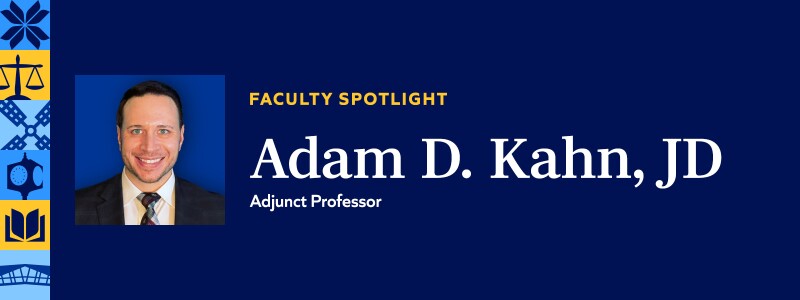
When Adam Kahn first walked into Hofstra University’s Maurice A. Deane School of Law, he didn’t know he would one day return as an adjunct professor in the university’s online Master of Arts (MA) and Master of Laws (LLM) in Health Law and Policy programs. He also didn’t know he’d eventually build a legal career at the intersection of elder law and health law, representing hospitals on complex patient treatment issues. What he did know was that he wanted to make an impact, and that law offered a unique way to do it.
“Rules are obviously a part of society, and it’s something that you can affect,” Kahn explained. “A lot of society, you can’t really affect. Things like culture—how do you wrap your head around that? But the rules, which are essentially our laws, are things that we can manipulate, we can engage with, and we can change. And then they have a ripple effect on the rest of society.”
That perspective has shaped his entire career, and it informs the way he teaches today.
A Career Shaped by Curiosity
With both parents working as physicians, Kahn was no stranger to the healthcare world. But his path into health law wasn’t a straight line. When he started law school, he was most interested in trusts and estates. It wasn’t until he began taking courses, including one taught by Professor Janet Dolgin on decision-making for children, infants, and incompetent adults, that his interests began to shift.
“I also found administrative law really interesting, and so much of health law is related to administrative regulations,” he said. “So I said, ’Oh, okay, well, maybe this is something that I could do on a more regular basis.’”
Today, Kahn practices at the intersection of elder law and health law, representing hospitals on guardianship matters, patient treatment issues, and decision-making for patients who lack capacity. His work is anything but routine. During the pandemic, he represented hospitals in cases where patients sought to compel physicians to provide certain forms of treatment that were not within established standards of care. In addition, he frequently works on cases to provide treatment for patients with mental illness and cognitive impairment, who often do not understand the nature of their condition or the recommended course of treatment.
“At the end of the day, with cases like that, I know that I’m having some kind of impact,” he reflected. “Even if the court disagrees, at least I know that I was representing the interest of trying to get the patient help within the boundaries of the law. And that’s within the boundaries of the law.”
Why He Chose Hofstra—and Why He Stayed
Ask Kahn why he came to Hofstra, and he’ll tell you the more interesting question is why he stayed.
“Part of that was because of the academic experience. I really liked my professors, I really liked the way that they approached my classes,” he said. “I still remain friends with a lot of them.”
As someone who didn’t grow up in New York, Kahn also found that Hofstra gave him something he didn’t have when he arrived: a network. He noted that the school’s regional footprint is strong.
Beyond personal connections, Kahn points to Hofstra’s institutional commitment to health law as a reason he’s proud to teach here. From partnerships with Northwell Health to the Medical-Legal Partnership clinic to the Gitenstein Institute for Health Law and Policy (where Kahn serves as a senior fellow), Hofstra has built an ecosystem around health law that extends well beyond the classroom.
The Power of a Mixed Classroom
One of the most distinctive features of Hofstra’s online health law programs is something you might not notice at first glance: the students in the virtual classroom aren’t all lawyers. They’re also nurses, physicians, hospital administrators, compliance officers, and healthcare executives. And for Kahn, that mix is one of the program’s greatest strengths.
“I like that we don’t segregate the LLM students and the MA students,” he said. “We have lots of opportunities to intermingle. By having attorney LLM students and master’s students who may be doctors, nurses, administrative professionals, you can get various perspectives.”
That diversity isn’t just good for classroom discussion. It mirrors the real world in which health law actually operates.
“It’s like an attorney working with a client,” Kahn explained. “That could happen in this program, where they’re both developing knowledge together.”
He recalled one former student, a nursing home administrator, as a prime example of how the program benefits non-attorney professionals. “A nursing home administrator is basically like a CEO of a nursing home. It’s a very business-related position, but you also have to deal with compliance and all of these other things. He had a lot of very practical knowledge about what is required to run a nursing home, but he didn’t have a lot of outside knowledge about things like informed consent.”
By the time he finished the program, that student had expanded his foundation well beyond business operations. “Now, as a nursing home administrator, instead of just being the business head of the organization, he had more knowledge about the clinical practice, the insurance side of things—these other things that impacted his job on a daily basis.”
For attorneys, the benefit works in reverse. Lawyers come in with strong analytical training but often lack the clinical, administrative, or operational context that makes health law come alive. Sitting alongside healthcare professionals helps fill those gaps in ways that textbooks can’t.
Inside the Capstone: A Self-Directed Deep Dive
Every student in the program eventually finds their way to Kahn’s classroom, because he teaches the capstone course—the culminating experience that ties the entire program together.
“The capstone is really a paper writing course,” Kahn explained. “It’s an opportunity to bring things together, to do your own research. It functions a bit like an independent study.”
The assignment is simple on paper: write a research paper on any topic related to health law and policy, including a component of legal analysis. In practice, the course becomes a deeply personal journey. Kahn guides students through topic selection, research, and writing, helping them shape something meaningful while ensuring the project is actually feasible within a single term.
The topics students choose reflect the breadth of the field, and often their own passions. Physician-assisted suicide comes up frequently. So does informed consent. One student wrote about obesity as a public health issue, examining policy interventions like New York City’s portion cap rule, taxes on sugary drinks, and proposals to restrict SNAP benefit purchases.
“In another program, you wouldn’t necessarily be looking at the law,” Khan said. “You’d be looking at public health research and social research. So I try to say, ’Listen, I know all this stuff is out there. Where’s the law in this? Let’s analyze that.’”
What makes the capstone meaningful, in Kahn’s view, isn’t just the finished product. Students get the permission and structure to finally dig into a topic they’ve always wondered about.
“The reality is, any of us could do research on any topic at any time,” he said. “But are we going to do it? Probably not. This is an opportunity to essentially say, ’You’re interested in an area? Well, now you have an assignment. Now you have to do the research, and you have to write about it, and you actually have to learn about this area.’”
During the peer review process, classmates learn about other topics as they review each other’s work. The result is a strong final paper.
More Than a Credential
Whether students come to these programs as seasoned attorneys, mid-career healthcare professionals, or recent graduates looking to specialize, Kahn believes the online Health Law and Policy programs offer something that’s hard to quantify but easy to recognize once you’ve experienced it.
“It’s not going to teach you how to be a healthcare attorney, because that’s just not how law practice works,” he said. “But it is going to give you a broader foundation to draw upon to make you a better attorney—or a better professional—overall.”
For Kahn, that’s the quiet power of the program. It doesn’t just hand you a credential. It reshapes the way you think about the problems you’re already trying to solve.
And for the students lucky enough to share a virtual classroom with peers from across the healthcare landscape? The education extends well beyond the syllabus.
Get Started on Your Own Health Law Journey
Hofstra University’s Maurice A. Deane School of Law offers online Health Law and policy programs that address the needs of a variety of working professionals. The Master of Laws (LLM) program is for attorneys ready to lead in healthcare law. The Master of Arts (MA) program is for healthcare professionals and advocates building legal expertise. And, if you’re not sure if you’re ready for the full LLM or MA program, consider the online Graduate Certificate in Health Law and Policy. Credits earned during this eight-month program seamlessly transfer to your preferred program. This low-risk pathway allows you to experience our program while enhancing your resume from day one.
Schedule a call with an admissions outreach advisor to explore your options and begin advancing your career today.